

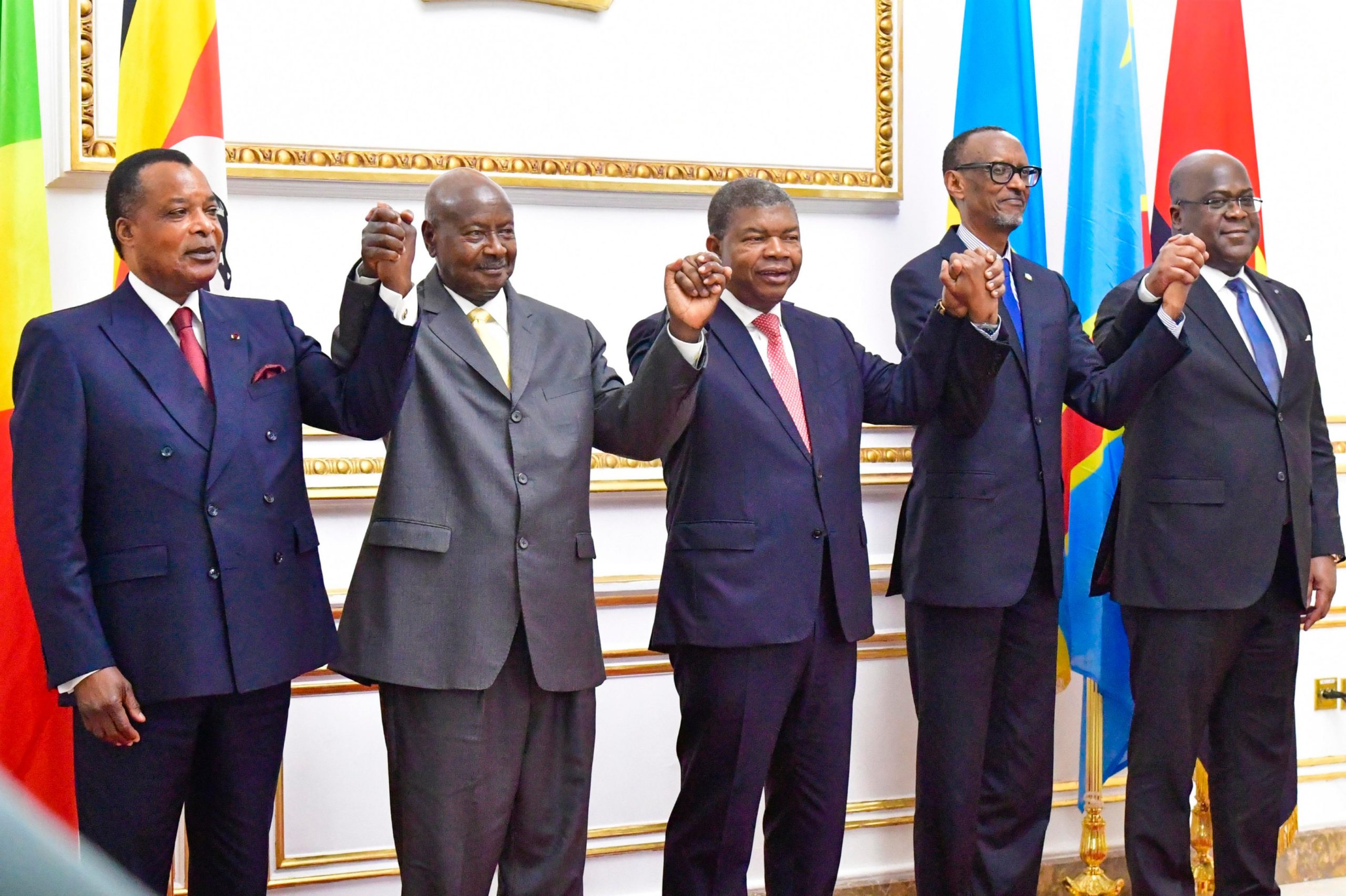
Announced with great fanfare by the Congolese Presidency, its press and communication organs, as well as the Congolese media, the mini-summit of heads of state of the Great Lakes region which was to meet this weekend at the Goma Hotel Serena : Presidents Yoweri Museveni of Uganda, Paul Kagame of Rwanda, Evariste Ndayishimiye of Burundi, João Lourenço of Angola and Felix Antoine Tshisekedi of DRC, did not take place.
The Burundian and Ugandan presidents stood up their Congolese counterpart. The Angolan president did not announce himself in Goma either.
Here are the elements of our analysis of the reasons of this announced fiasco:
1) Burundi and Uganda consider that Goma is within direct military reach of Kagame and indirect of militias in his pay. Let us recall the words of Rwandan General James Kabarebe who declared in all relaxation that Rwanda controls every square centimeter of the east of the DRC, while specifying that he “knows very well the situation of Kivu and everyone there.”
2) Burundi is in a latent war with Rwanda, and Uganda is in a serious diplomatic and security crisis with Rwanda.
3) In the note verbale from the Burundian Minister of Foreign Affairs, addressed to his Congolese counterpart, we read that Burundi would first like to deal with security issues at the common borders with the DRC before involving the other neighboring states. In addition, according to confidential information received by DESC from a Burundian diplomatic source, Burundi believes that President Tshisekedi’s entourage does not master the challenges of the sub-region and is made up of people close to Kigali, including Claude Ibalanky and Fortunat Biselele. They exercise great influence over President Tshisekedi in matters affecting the Great Lakes. In addition, the Burundian authorities believe that the new Congolese authorities show very little consideration towards them following the negative influence of Kabila and Kagame while the two countries can develop a strategic partnership that would resolve the regional crisis as a whole. They give as proof, the absence of a high-level delegation both during the funeral of Nkurunziza and the swearing-in of the new Burundian president, Evariste Ndayishimiye. However, countries like Congo Brazzaville sent a strong high-level delegation respectively. Finally, the Burundian authorities privately deplore the fact that President Tshisekedi did not seek to associate Tanzania, probably to please Kagame who does not maintain cordial Dar-es-Salaam relations either.
4) According to our sources, Uganda has evoked the same wish. In addition to the security problems of its delegation, Uganda believing that it is Rwanda which constitutes the problem of the sub-region.
5) Presumably, in-depth bilateral preparatory meetings initiated by Congolese diplomacy were not carried out well upstream to meet the desiratas of the various stakeholders at this mini summit. Likewise, the Congolese emissaries did not obtain formal confirmations from the senior Ugandan and Burundian authorities relating to their presence in Goma, which also demanded other meticulous and drastic security adjustments and clear guarantees from the Congolese side. This does not appear to have been accomplished, according to our local Congolese security sources.
6) Choosing a safe meeting environment for Rwanda is a strategic error of appreciation and an apparent indication of incompetence and inconsistency of the advisers/collaborators of President Tshisekedi. They did not understand that the choice of a negotiating framework remains very decisive in diplomacy for the success of a summit.
7) The Congolese presidency and its plethora of communication and press services should have adopted a low (strategic) profile rather than blindly launching into the effect of triumphalist announcement with great fanfare of a summit where everything was played out on the edge of the razor seen the reciprocal mistrust of the various stakeholders in this mini-summit.
Diplomacy is also an art which consists of anticipating and preventing strategic ruptures, in particular through a fine and rigorous analysis of the geopolitical issues of each protagonist in a conflict where improvisation has no place.
