
In less than a decade, Africa has once again become a destination for mercenaries. Meanwhile, Russia, Ukraine and Israel are recruiting Africans to fight on the front line or work in arms factories.
A combination of factors has made Africa a major destination for dogs of war. The jihadist threat in the Sahel following the destruction of Libya by Sarkozy and Cameron in 2011, civil wars in the Central African Republic, Sudan and Somalia, and the war in the Democratic Republic of Congo are among the main factors for the rising demand for mercenaries on the continent. The lack of skills, equipment and incentives for poorly paid soldiers explains the inefficiency of many African armies and the need to hire mercenaries to cope with immediate threats.
At the same time, the protagonists of the war in Ukraine, which both suffer from a shortage of military manpower, have recruited Africans either to fight on the front or work in the arm factories, making Africa a huge import-export hub of mercenaries.
The expansion of Russia’s PMC Wagner, which was replaced by the Africa Corps under closer Kremlin control, is well documented. In November 2025, the Russian state-owned television channel Russia Today reported on the presence of the Africa Corps, the successor group to Wagner, in several African countries, including Mali, Burkina Faso, Niger, Togo, Equatorial Guinea, the Central African Republic (CAR) and Libya. Comprising mostly veterans of Russia’s ‘Special Military Operation’ in Ukraine, the Africa Corps mercenaries utilise heavy weaponry, including fighter and bomber aircraft, helicopters, drones, and armoured vehicles.
Turkish SADAT
The Turkish private military company (PMC) SADAT has spread its tentacles all over the continent, mainly providing an after-sales service to clients of Turkish weapons. It provides support for Turkish Bayraktar TB2 drones, which are used by countries including Ethiopia, Morocco, Algeria, Tunisia, Libya, Burkina Faso, Niger, Togo, Nigeria, Chad, Sudan, Somalia, Angola and Rwanda. In 2019, SADAT signed a contract with the Libyan company Security Side, which is led by Sameh Bukatef of the Muslim Brotherhood, to train militias associated with the Tripoli-based Government of National Accord.
SADAT also provides services to over 20 states that have signed security and defence cooperation agreements with Turkey.
The war in the DRC has created many opportunities for mercenaries. In an attempt to stop the advance of the M23 rebels, who are backed by Rwanda, in eastern Congo, Kinshasa hired the Bulgarian firm Agemira in 2024. Founded by former French gendarme Olivier Bazin, the company’s 120 employees operated Chinese-made CH4 Rainbow drones and FARDC aircraft until September of last year. Kinshasa also hired the Congolese security firm of former French Foreign Legion officer Horatius Potra. However, the operation was a complete disaster, as evidenced by Potra’s 300 Romanian recruits surrendering to the M23 in early 2025. Last year, the DRC government signed a $700 million contract with Erik Prince, founder of the private military company Blackwater, to help secure and tax the DRC’s mineral resources.
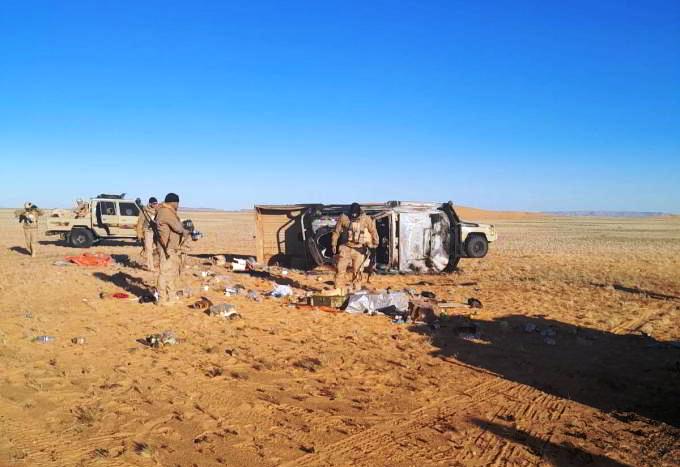
Colombia is another important provider, as many of its 250,000-strong military, recruited at the beginning of the millennium, are now retiring and seeking lucrative employment abroad where they can sell their counterinsurgency skills. According to the daily newspaper The Guardian, companies owned by individuals sanctioned by the US have hired hundreds of Colombian fighters for the Sudanese Rapid Support Forces, who have been accused of war crimes. These mercenaries reportedly served as instructors and pilots for the drones that were instrumental in helping the RSF capture the south-western Sudanese city of El Fasher in late October.
The man at the centre of the RSF’s recruitment network is Álvaro Andrés Quijano Becerra, a retired Colombian colonel who is based in the United Arab Emirates (UAE). Acting on behalf of a Colombian company called A4SI (Academy for Security Instruction), he organised the recruitment of around 300 Colombian soldiers. The Guardian also found that Zeus Global, a London-based company founded by Becerra’s wife, Claudia Viviana Oliveros, and a Colombian-Spanish national named Mateo Andrés Duque Botero, was also involved in this business.
Chinese Private Security Companies.
The Atlas Institute has highlighted the growth of Chinese private security companies in Africa. In a November 2025 paper, the institute claimed that China had established a network of state-linked security contractors operating in Djibouti, Ethiopia, Kenya, Somalia, South Sudan, Egypt, Algeria, Libya, Morocco, Nigeria, the Democratic Republic of the Congo, the Central African Republic, and Mali. These companies employ thousands of former People’s Liberation Army personnel who provide personal protection, site security, and risk assessments, but do not engage in offensive operations or combat support.
One of the most notable companies is Beijing DeWe Security Service. Founded in 2011, it currently employs 2,000 contractors to protect Kenya’s Standard Gauge Railway and Ethiopia’s natural gas project. Another notable company is Frontier Services Group, which was founded by Erik Prince and is now wholly owned by China’s CITIC Group. It operates in the Democratic Republic of the Congo (DRC), Kenya, Nigeria and South Sudan, where it protects mining sites and infrastructure.
Israeli companies are also present on the market. For several decades, Eran Moas, a former executive at the Israeli surveillance and radar technology company Tadiran, has been training the elite Rapid Intervention Brigade of Cameroonian President Paul Biya. In the DRC, Yariv Chen Consultants & Security, a company founded by a former member of Unit 730 of the Israeli domestic intelligence service Shin Bet, provides close protection to President Félix Tshisekedi. Since 2023, Yariv Chen’s team has been training around 1,600 members of Tshisekedi’s Republican Guard at a camp near Lubumbashi.
Lured to fight Ukraine and the Gaza strip
South Africa is not only home to notorious private military companies (PMCs) such as Executive Outcomes. It is also a country where foreign states recruit mercenaries and labourers for their arms industries. The most recent example of this occurred on 28 November 2025, when four men were arrested at Johannesburg airport for recruiting young South Africans to fight as mercenaries for the Russian armed forces. South African police suspect that SABC TV presenter Nonkululeko Mantula facilitated this recruitment.
This did not surprise Darren Olivier, director of the African Defence Review, who told the South African publication Daily Maverick that the country had seen an increase in recruitment schemes targeting South African citizens for Russia’s war in Ukraine. Accordingly, he believes that there are likely to be at least a dozen other instances.
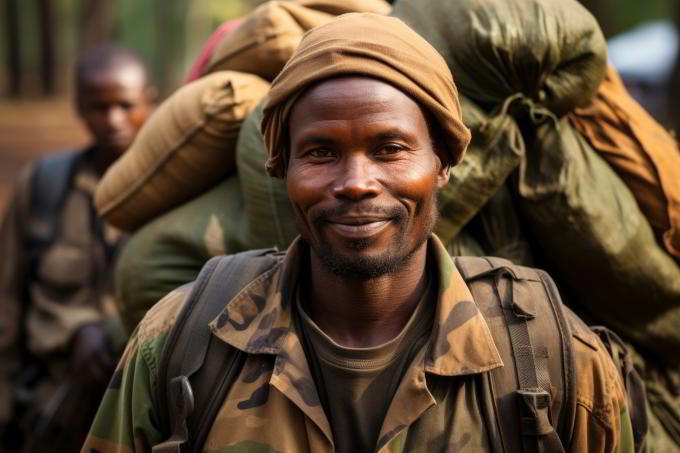
Olivier suggests that more than a thousand African citizens from across the continent have travelled to Russia to join the military or private mercenary groups, or to work in munitions factories. Some have been lured by promises of jobs as bodyguards, only to be coerced into fighting on the Ukrainian front once they arrive in Russia. According to News24, Duduzile Zuma-Sambudla, the daughter of former president Jacob Zuma, and other members of the uMkhonto Wesizwe (MK) party are involved in this business. Recruited individuals were made to sign Russian-language contracts that they did not understand, and ended up in the Ukrainian trenches. The scandal reached such proportions that Zuma-Sambudla resigned from parliament as an MK party MP.
In 2024, reports emerged of the recruitment of hundreds of African women to work at a drone assembly plant in Alabuga, Tatarstan, around 1,000 km from Moscow. The French channel TV5 Monde reported that young Cameroonian women had received Russian scholarships as part of the Alabuga Programme. Ultimately, these women ended up working at the Albatros drone factory, where all types of UAV used in the ‘Special Operation’ in Ukraine are assembled. The plant was bombed in 2024, injuring several women.
By mid-December 2025, TV-5 Monde had broadcast a programme on 200 Kenyan recruits who had been lured to fight in the Russian military in Ukraine. The recruits had previously filled job application and scholarship forms. The Nairobi Daily Nation identified the names of 82 of the recruits, including those who had been killed, wounded or captured by the Ukrainian army. The recruits had paid the equivalent of 460 to 1,300 euros to recruitment officers, who had promised them monthly salaries of about 2,000 euros. In a communiqué released on 27 October 2025, the Kenyan Foreign Ministry said that the recruits were dispersed in different military camps across Russia. In November of last year, the Ukrainian Foreign Minister Andriy Sabiha claimed that 1,436 African nationals from 36 countries had joined the Russian army by then.
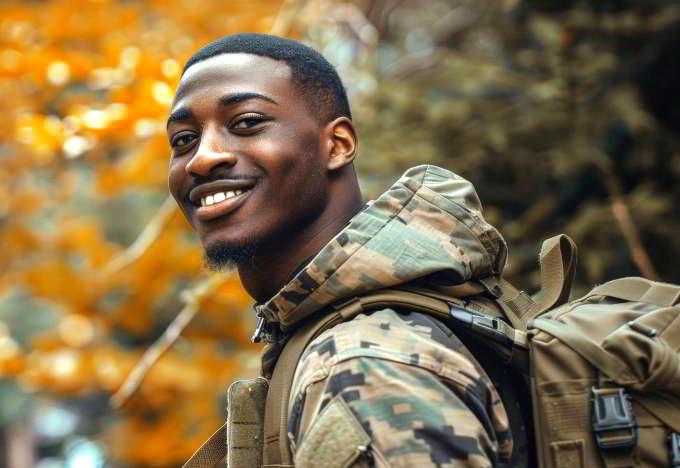
At the start of the war, Ukraine had been actively recruiting African mercenaries. In March 2022, Deutsche Welle reported that Nigeria, Senegal and Algeria condemned Ukraine’s efforts to enlist international fighters against the Russian invaders. Kyiv also attracted foreign fighters from Kenya, meeting the demand from unemployed young men. Director of Signal Risk, Ryan Cummings, said that President Volodymir Zelenskyy was then capitalising on Africa’s poor socioeconomic conditions to lure African fighters to Ukraine. In return, these African mercenaries were offered Ukrainian citizenship or financial compensation.
Inspired by the Ukrainian example, Israel has also been recruiting African asylum seekers to combat its manpower shortage following the Hamas attack of October 2022. In September 2024, the Haaretz daily reported that Tsahal had been recruiting African asylum seekers for its operations in Gaza, promising them residence permits in compensation. This issue mainly concerns Africans, as the majority of Israel’s 30,000 asylum seekers are Eritrean or Sudanese citizens. This phenomenon has reached global proportions.
François Misser
